
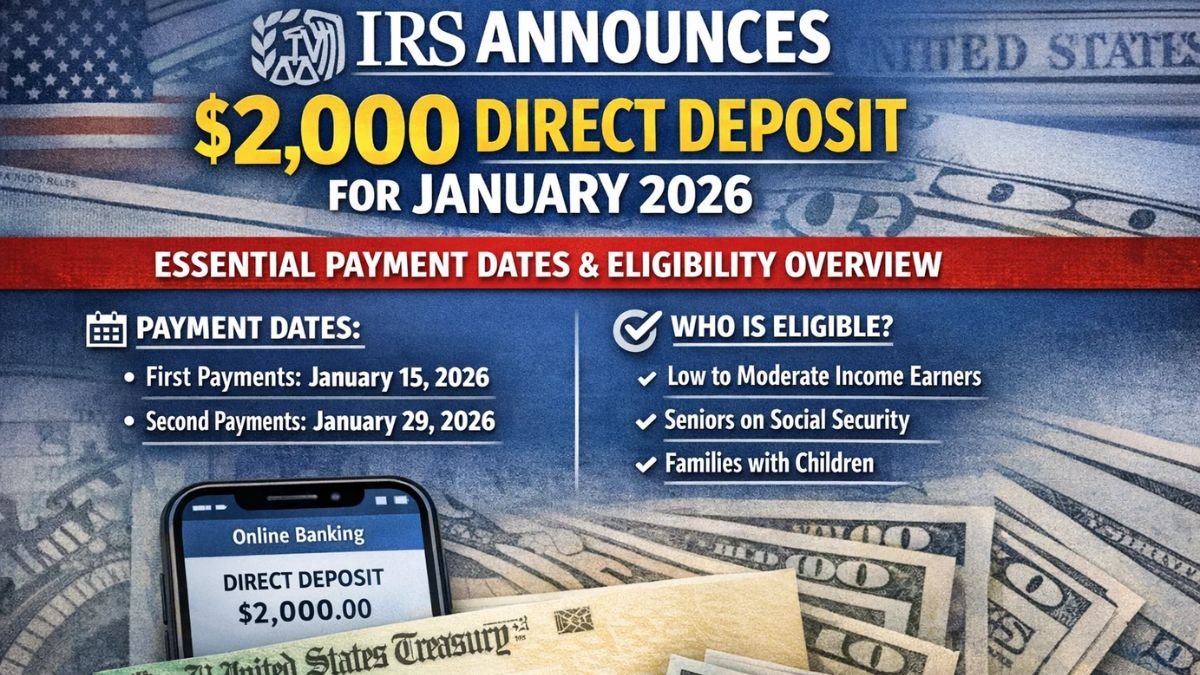
The beginning of a new year often brings financial expectations, resolutions, and questions for millions of Americans. As January 2026 approaches, discussions around a potential $2,000 direct deposit from the Internal Revenue Service have gained widespread attention. For households managing rising costs, tax obligations, and everyday expenses, any form of direct payment from the IRS naturally becomes a point of interest. While the idea of a $2,000 deposit sounds straightforward, the reality behind such payments is usually more layered, involving eligibility criteria, timelines, and administrative processes that deserve careful understanding.
This article offers a clear and humanized overview of the reported $2,000 IRS direct deposit for January 2026. It explores what such a payment could represent, who may qualify, how the IRS typically schedules deposits, and what taxpayers should realistically expect as the new year begins.
Understanding the Context of the $2,000 IRS Direct Deposit
Whenever news circulates about an IRS payment, it is important to understand that the agency does not issue money randomly. Any direct deposit tied to the IRS usually falls into one of several categories, such as tax refunds, refundable tax credits, economic relief payments authorized by law, or adjustments connected to prior tax filings. The mention of a $2,000 direct deposit for January 2026 has led many people to assume a new nationwide stimulus, but in most cases, such payments are connected to existing tax mechanisms rather than brand-new programs.
For many taxpayers, the $2,000 figure may reflect an average or maximum amount associated with refundable credits or early refunds processed at the start of the tax season. The IRS often begins limited processing activities in January, especially for taxpayers who filed early or whose returns involve straightforward income and withholding details. Understanding this context helps set realistic expectations and reduces confusion fueled by headlines alone.
Why January Is a Key Month for IRS Payments
January holds special importance in the tax calendar. It marks the transition between tax years and the preparation phase for the upcoming filing season. Employers finalize W-2 forms, financial institutions issue interest and investment statements, and taxpayers begin organizing their documents. During this period, the IRS also completes backend updates to its systems, enabling it to process returns and issue refunds efficiently once filing officially opens.
In some cases, certain payments or corrections are scheduled for January because they relate to the previous tax year. If a taxpayer overpaid taxes, qualified for refundable credits, or had adjustments pending from earlier filings, January can be the month when those funds finally reach their bank accounts. This timing explains why a $2,000 direct deposit could realistically appear in January 2026 for eligible individuals.
What the $2,000 Payment May Represent
The reported $2,000 direct deposit is not necessarily a flat payment that everyone receives. Instead, it may represent the upper end or a commonly cited amount linked to tax refunds or credits. For example, refundable credits related to income, dependents, or education can significantly increase a taxpayer’s refund. When combined with withheld taxes throughout the year, the total refund amount can reach or exceed $2,000.
Additionally, some taxpayers may receive deposits due to amended returns or delayed processing from earlier years. If the IRS resolved an issue or correction late in the previous year, January 2026 could be when the final payment is issued. In this sense, the $2,000 figure serves as a general reference rather than a guaranteed or universal amount.
Eligibility Considerations for January 2026 Payments
Eligibility for any IRS-issued direct deposit depends heavily on individual tax circumstances. Income level, filing status, dependents, and tax withholding all play a role in determining whether someone qualifies for a payment and how much they receive. Taxpayers who filed complete and accurate returns, maintained up-to-date banking information, and met the requirements for refundable credits are typically more likely to see early deposits.
Another important factor is compliance. The IRS prioritizes payments to individuals whose tax records are clear and require minimal verification. Returns flagged for review, identity confirmation, or missing information often experience delays. As a result, two taxpayers with similar incomes could have very different timelines depending on the complexity of their filings.
Direct Deposit Versus Paper Checks
Direct deposit remains the fastest and most reliable way to receive money from the IRS. Taxpayers who have authorized direct deposit on their returns or through prior filings usually receive funds days or even weeks earlier than those waiting for paper checks. The January 2026 payment discussions strongly emphasize direct deposit because the IRS continues to encourage electronic transactions for efficiency and security.
Paper checks, while still an option, involve printing, mailing, and delivery times that can stretch payments well into February or later. For individuals expecting funds around January, ensuring that banking details are accurate and current can make a meaningful difference in when the money arrives.
Expected Payment Dates and Timing
Although the IRS does not typically announce exact payment dates far in advance, patterns from previous years offer helpful guidance. Early payments connected to refunds or credits often begin appearing in mid to late January, depending on when returns are processed. If January 2026 follows a similar timeline, eligible taxpayers could start seeing deposits within the first few weeks of the month.
However, it is important to remember that IRS payment schedules are not uniform. Some individuals may receive deposits earlier due to simpler returns, while others may wait longer if their filings require additional checks. Holidays, weekends, and system maintenance can also influence timing, making patience an essential part of the process.
Common Reasons for Delays
Even when a payment is expected, delays can occur for several reasons. Incorrect bank account numbers, mismatched personal information, or unresolved tax issues can all slow down processing. Identity verification measures, which have become more robust in recent years, may also extend timelines for certain taxpayers.
Another common reason for delays involves refundable credits that require additional review. While these credits provide valuable support, they often come with stricter verification requirements. As a result, payments associated with them may arrive later than standard refunds.
How Taxpayers Can Prepare
Preparation plays a major role in avoiding stress and uncertainty. Keeping personal information updated, reviewing past tax filings for errors, and responding promptly to IRS notices can all help ensure smoother processing. Taxpayers who expect a January 2026 payment should also monitor official IRS communications rather than relying solely on social media or unofficial sources.
Using IRS online tools to track refunds and account activity can provide clarity and reduce anxiety. These tools are designed to give real-time updates and help taxpayers understand where their payment stands in the processing pipeline.
The Emotional Impact of IRS Payments
Beyond numbers and dates, IRS payments often carry emotional weight. For many families, a $2,000 deposit can help cover rent, utilities, medical bills, or lingering holiday expenses. The anticipation of such funds can bring hope, but uncertainty can also lead to frustration. Recognizing this emotional dimension is important when discussing IRS payments, as financial stability is deeply personal and closely tied to overall well-being.
Understanding the process helps transform anxiety into informed patience. When taxpayers know what to expect and why delays may happen, they are better equipped to plan responsibly and avoid unnecessary panic.
Conclusion
The conversation around a $2,000 IRS direct deposit for January 2026 reflects both financial need and widespread curiosity about how the tax system works. While such a payment is not a guaranteed universal benefit, it represents a realistic outcome for many taxpayers based on refunds, credits, or prior adjustments. Eligibility depends on individual circumstances, accurate filings, and timely processing by the IRS.
As January 2026 approaches, the most reliable approach is preparation and awareness. Staying informed, maintaining accurate records, and understanding IRS timelines can make the difference between confusion and confidence. Ultimately, whether the amount is exactly $2,000 or more or less, the key lies in knowing how the system works and allowing it the time it needs to deliver what taxpayers are rightfully owed.
FAQs
Q1. What is the IRS $2,000 direct deposit for January 2026?
A. It is a proposed IRS payment of $2,000 aimed at providing financial relief to eligible taxpayers.
Q2. When will the $2,000 payment be deposited?
A. Payments are expected to begin in January 2026, with exact dates depending on IRS processing schedules.
Q3. Who is eligible for the $2,000 IRS payment?
A. Eligibility generally depends on income limits, tax filing status, and residency requirements.
